Bumble Bee Nests
Updated: 3rd January 2024
I have fond memories of finding, then observing an active bumble bee nest as a child.
I remember it very clearly – so much so, that I can even name the species, even though it happened many years ago. It was the nest of a white-tailed bumble bee (Bombus lucorum), and I suspect a queen in the early stages of establishing her colony.
The nest had been made at the base of our privet hedge in what appeared to be a mouse hole. I now know this is common among some bumble bee species – they like to use abandoned rodent holes. Rodent holes are ideal, in that they consist of a ready-made, underground shelter, complete with nest lining.
Where Do Bumble Bees Nest?
Some bumble bee species nest in the ground. Abandoned mouse holes, natural cavities caused by tree root systems or due to the arrangement of rocks in the land scape, could all provide a home.
The photograph below is the nest site of the same species of bumble bee - a colony of white-tailed bumble bees.
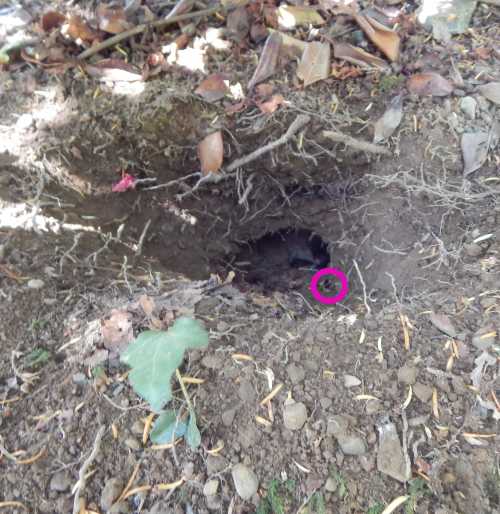 Ground nest of white-tailed bumble bee, with bee entering.
Other bumble bee species prefer to nest on open ground - carders in particular. They will seek out a suitable tuft of grass, sometimes with a natural indentation.
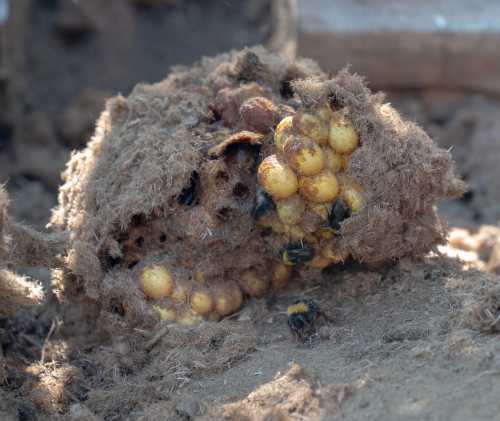
Pictured below is a soft, mossy nest of a common carder bumble bee (Bombus pascuorum) .
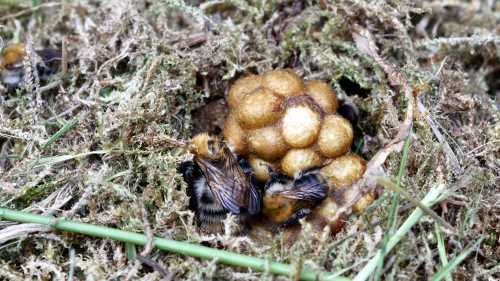 Nest of a common carder bumble bee (Bombus pascuorum).
However, having a nest out in the open potentially makes such nest sites more vulnerable to predator attack, or indeed, accidental damage if the site is accessible by humans or vehicles.
High up crevices and holes in trees can also provide opportunities, along with man-made crevices, such as eaves of buildings, cracks in walls, or an unused bird nest box.
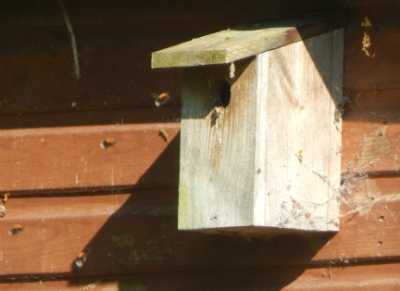 Bumble bee nest in bird nest box.
So how do bumble bees go about locating and setting up nests?
Prospecting For Nest Sites
Nests are established by an impregnated queen after she has emerged from hibernation and has re-fuelled herself with nectar and pollen. The nectar will provide her with much needed energy, whilst the pollen will help her ovaries to develop. Once she has recovered from her winter snooze, she’ll go looking for suitable nest sites.
Tell tale signs of queen bumble bees prospecting for nest sites:
- zig-zagging or flying low across the ground, apparently exploring dips and bumps along the grassy ground.
- exploring other shady areas and crevices - such as underneath the garden shed, or around holes and crevices in walls or the bases of trees, gaps in compost bins.
- Hovering around or bumping into the windows of your house.
Again, they are attracted to the shade, in case it signals a ready-made
cavity where there might be a suitable site for a nest.
Challenges faced by bumble bees in the search for a suitable nest site
For a variety of reasons, bumble bees have suffered greatly because of habitat destruction. Not only have they lost valuable foraging sites, they have lost nesting sites too. How come?
1. Lack Of Hedgerows
Modern farming practices have resulted in the grubbing up of many
traditional, mixed hedgerows. The base of hedgerows provide ideal places for small rodents
and voles to make their nests.
Fewer hedgerows means fewer small
mammals, and so fewer available nest sites.
2. Loss Of Wildflower Landscapes
Again, for the sake of modern farming practices or for the sake of building and road development, many of the kinds of landscapes providing tussocky grasses and ample wild flowers that provide suitable habitat for surface nesting species, have been lost.
For example, in the UK, an astonishing 98% of such landscape has disappeared, along with important bumble bee habitat.
Hence, wildflower meadows and grasslands have been lost to the detriment of many bumble bee species.
Fortunately, nowadays many farmers are working hard to help pollinators, for example, by planting pollinator strips.
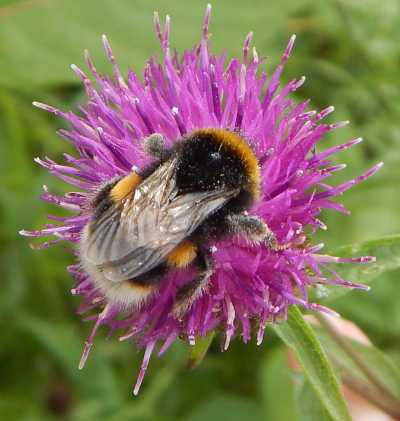 White-tailed bumble-bee - Bombus lucorum - queen, foraging on knapweed.
3. Destruction Of Woodlands
Woodlands, again because they provide a rich diversity of flora and
fauna, provide great habitats. However, it is well known that we have
lost many of our woodlands, again for the sake of ‘development’.
The lack of available nest sites has definitely had a very negative impact on populations of bumble bees. Some species however, have been able to adapt somewhat, through necessity, whilst for others this has not been possible.
It’s important to note that fewer than half of colonies are successful, and nest disturbance is a significant factor, whether through human activity or predators.
However, we humans can help, by creating bee-friendly gardens, and providing suitable bumble bee nest sites in our gardens.
How can we help bumble bees?
We will benefit greatly when bumble bees pollinate our plants (especially our soft fruits and beans). They are very docile and will only rarely sting if they feel very threatened.
In particular, we can:
- plant hedgerows
- leave bumble bee nests undisturbed if we find one - they only last a season.
- ensure we have lots of nectar and pollen rich plants, and a pesticide-free, bee-friendly garden
- provide alternative nest sites with a little hamster bedding - bird boxes, or an old tea pot under the shed, for example.
References
Osborne, J.L., Martin, A.P., Shortall, C.R., Todd, A.D., Goulson, D., Knight, M.E., Hale, R.J. and Sanderson, R.A. (2008), Quantifying and comparing bumblebee nest densities in gardens and countryside habitats. Journal of Applied Ecology, 45: 784-792. https://doi.org/10.1111/j.1365-2664.2007.01359.x